Buy or rent our products online!
Personalized Brain Care at Bhakti Brain Health Clinic
At Bhakti Brain Health Clinic, we recognize that no two brains are alike. Each person’s brain has developed through a unique combination of genetics, life experiences, stress, learning, and environment. Because of this, effective brain care must be personalized, not generic.
Brain mapping using quantitative EEG (qEEG) is one of the most advanced tools we use to understand how an individual’s brain is functioning. Rather than focusing only on symptoms, qEEG allows us to observe brain activity patterns, communication between brain areas, and overall balance within the brain system.
This modern neuroscience-based approach helps us design customized, brain-based treatment plans that support mental health, emotional regulation, cognitive performance, and long-term brain wellness.
At Bhakti Brain Health Clinic, brain mapping is not about labeling or diagnosing. It is about understanding, guiding care, and supporting the brain’s natural ability to regulate and heal.
Understanding the Brain: The Foundation of Personalized Care
Before exploring how qEEG works, it is important to understand how the brain is organized and how it influences daily life.
The Brain as a Central Control System
The brain is the main control center of the central nervous system. Together with the spinal cord and peripheral nerves, it regulates:
- Thoughts and emotions
- Behavior and decision-making
- Movement and coordination
- Memory and learning
- Sleep and alertness
- Sensory input from the body
Every experience, action, and feeling is shaped by how different brain areas communicate.
Neurons, Cells, and Brain Communication
The brain is composed of billions of specialized cells, known as neurons, which are also referred to as nerve cells. These neurons communicate through complex electrical and chemical processes known as neuronal signaling.
Key components include:
- Dendrites, which receive information
- Axons, which transmit signals
- Synapses, where neurons connect and communicate
- Action potentials, which are electrical impulses traveling along neurons
This continuous flow of electrical activity creates measurable brain activity, which qEEG is designed to record and analyze.
Grey Matter and White Matter
The brain contains two major types of tissue:
- Grey matter, which contains neuron cell bodies and is responsible for processing information
- White matter, which contains axons and supports communication between different brain areas
Healthy communication between grey matter and white matter is essential for attention, memory, emotional regulation, and coordinated movement.
Major Brain Structures and Their Roles
Cerebrum
The cerebrum is the largest part of the brain and is responsible for higher functions such as thinking, reasoning, memory, behavior, and voluntary movement.
Cerebellum
The cerebellum supports balance, coordination, timing, and smooth movement. It also plays a role in learning and emotional regulation.
Brain Stem
The brain stem controls vital functions such as breathing, heart rate, sleep-wake cycles, and basic alertness.
Spinal Cord
The spinal cord connects the brain to the body, carrying motor and sensory signals that support movement and bodily awareness.
The Lobes of the Cerebral Cortex
The cerebral cortex is divided into distinct lobes, each with specialized functions.
Frontal Lobes
- Focus and attention
- Decision-making
- Emotional regulation
- Impulse control
- Motor planning and movement
Temporal Lobes
- Memory formation
- Language understanding
- Emotional processing
Parietal Lobes
- Sensory input integration
- Spatial awareness
- Body perception
Occipital Lobes
- Visual processing
Deeper Brain Systems
Several deeper structures play a critical role in emotional and behavioral regulation:
- The limbic system, which influences emotions, stress response, and memory
- The basal ganglia, which support movement, habit formation, and regulation
- The prefrontal cortex, which governs self-control, planning, and executive functions
qEEG helps observe how these systems interact and whether they are working in balance.
How Brain Activity Shapes Daily Life
The way brain areas communicate directly affects:
- Behavior and emotional responses
- Sleep quality and energy levels
- Learning and memory
- Stress resilience
- Motor coordination and movement
Understanding these patterns is essential for personalized brain care.
What Is Brain Mapping (qEEG)?
Defining Quantitative EEG
Quantitative electroencephalography (qEEG) is a non-invasive method used to measure and analyze the brain’s electrical activity. It provides a detailed map of how different areas of the brain are functioning and communicating.
At Bhakti Brain Health Clinic, qEEG is used as a functional assessment tool, offering insights into brain patterns rather than medical diagnoses.
How Brain Signals Are Recorded
During a qEEG session:
- A soft cap with sensors is placed on the scalp
- The sensors detect natural electrical signals produced by neurons
- No electricity is sent into the brain
- Brain activity is recorded while the person rests or completes simple tasks
These signals reflect how groups of neurons are firing together across the brain.
Traditional EEG vs qEEG
- Traditional EEG focuses on identifying major abnormalities
- qEEG uses advanced computer analysis to measure patterns, balance, and connectivity
qEEG provides a more detailed view of brain organization, making it especially valuable for personalized care planning.
Mapping Multiple Brain Areas Simultaneously
One of the strengths of qEEG is its ability to analyze multiple brain areas at the same time. This allows clinicians to observe:
- Communication between hemispheres
- Coordination across the frontal lobes and the temporal lobes
- Activity patterns in motor and sensory regions
- Whole-brain system balance
Why Bhakti Brain Health Clinic Uses qEEG
We use qEEG because it aligns with our mission of evidence-based, personalized brain care. Brain mapping allows us to move beyond guesswork and create treatment plans informed by each individual’s brain activity.
How Bhakti Brain Health Clinic Uses qEEG Data
Identifying Brain Activity Patterns
qEEG helps us identify patterns such as:
- Overactive brain regions
- Underactive brain areas
- Imbalances between hemispheres
- Inefficient communication through the corpus callosum
These patterns often relate to challenges in focus, mood regulation, sleep, or emotional balance.
Understanding Brain Balance
Healthy brain function depends on balance within the nervous system. qEEG helps us understand whether certain areas are working too hard or not enough, allowing for targeted support.
Linking Symptoms to Brain Areas
Rather than focusing on symptoms alone, we look at how symptoms may relate to activity in specific brain regions, such as:
- Frontal lobes and attention or impulse control
- Limbic system and emotional regulation
- Temporal lobes and memory processing
- Motor areas and movement coordination
Seeing the Whole Brain System
At Bhakti Brain Health Clinic, we emphasize whole-brain understanding. Brain mapping helps us see how different areas interact as a system, rather than treating isolated concerns.
Creating Personalized Treatment Plans at Bhakti Brain Health Clinic
Why No Two Brains Are the Same
Each brain develops uniquely based on:
- Neural development
- Life experiences
- Stress exposure
- Learning patterns
- Lifestyle and environment
Because of this, effective care must be individualized.
How qEEG Guides Personalized Strategies
qEEG data helps guide:
- Brain-based therapy planning
- Neurofeedback and neurotherapy approaches
- Supportive counseling strategies
- Lifestyle and stress-management guidance
Treatment is designed to support healthier brain regulation, not to force change.
Neurofeedback and Supportive Therapies
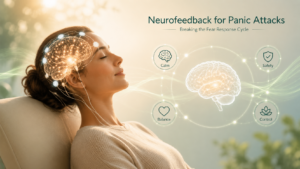
Neurofeedback is one of the tools that may be used to help the brain learn more balanced activity patterns. It is guided by qEEG findings and adjusted over time based on progress.
Tracking Progress Over Time
Brain health is not static. At Bhakti Brain Health Clinic, we:
- Monitor changes in brain activity
- Adjust care plans as needed
- Focus on sustainable improvements
- Support long-term brain wellness
Conditions That May Benefit from qEEG-Guided Care
qEEG-guided care may support individuals experiencing:
- Anxiety and stress-related patterns
- Mood regulation challenges
- Attention and focus difficulties
- Trauma-related stress responses
- Sleep disturbances
- Cognitive performance concerns
- Memory and emotional regulation difficulties
All care is supportive and individualized, not diagnostic.
Brain–Body Connection in Personalized Healing
The Nervous System and the Body
The brain works closely with the body through the nervous system, including:
- The spinal cord
- Cranial nerves
- Motor neurons
- Sensory input pathways
This coordination affects posture, movement, behavior, and emotional responses.
Movement, Sensation, and Behavior
Signals from the brain guide movement and behavior, while sensory input from the body informs the brain. Bhakti Brain Health Clinic considers this two-way communication essential for holistic care.
A Whole-Person Approach
We recognize that brain health is influenced by sleep, stress, movement, and lifestyle. Our approach integrates these factors into personalized care plans.
Safety, Comfort, and Patient Experience
A Gentle and Non-Invasive Process
qEEG is:
- Drug-free
- Non-invasive
- Painless
- Safe for children and adults
What to Expect During a qEEG Session
Patients can expect:
- A calm, comfortable environment
- Clear explanations at every step
- A relaxed recording process
- Supportive care from trained professionals
Why Choose Bhakti Brain Health Clinic
Bhakti Brain Health Clinic is dedicated to:
- Personalized, data-driven brain care
- Evidence-based neuroscience practices
- Compassionate, patient-centered support
- Long-term brain health and resilience
We focus on understanding the brain, not just managing symptoms.
Frequently Asked Questions (FAQs)
What is qEEG brain mapping at Bhakti Brain Health Clinic?
It is a non-invasive assessment that measures brain activity patterns to support personalized care planning.
How does brain mapping support personalized treatment?
qEEG helps identify unique brain activity patterns, guiding individualized therapy strategies.
Is qEEG safe for children and adults?
Yes. qEEG is gentle, non-invasive, and suitable for all age groups.
How long does a qEEG assessment take?
Most sessions take approximately 60 to 90 minutes, including preparation.
What happens after brain mapping?
Results are reviewed carefully and used to design a personalized brain-based care plan.
How does Bhakti Brain Health Clinic personalize care?
We integrate qEEG data, clinical insight, and individual goals to create customized treatment strategies.
Does qEEG provide a diagnosis?
No. qEEG is a supportive tool used to understand brain function and guide care.
Supporting Brain Health Through Understanding
At Bhakti Brain Health Clinic, we believe that understanding the brain is the first step toward meaningful, lasting change. Through qEEG brain mapping and personalized neurotherapy, we aim to support healthier brain function with clarity, compassion, and evidence-based care.