Buy or rent our products online!

For a meaningful number of people who contracted COVID-19, recovery didn’t mean a full return to their previous level of functioning. Among the most commonly reported and often most disruptive lingering symptoms is a persistent cognitive fog, difficulty concentrating, word-finding trouble, slowed thinking, and short-term memory lapses that can significantly affect work, relationships, and daily confidence. As research into long COVID has expanded, interest has grown in whether brain-based approaches like neurofeedback might offer meaningful support for this specific, often frustrating symptom cluster.
This article looks at what’s currently understood about long COVID’s effects on the brain, what research suggests about neurofeedback in this context, and how it might fit into a broader, coordinated approach to recovery.
What’s Understood About Long COVID and the Brain
Long COVID, also referred to in some clinical and research contexts as post-acute sequelae of COVID-19, is an area of active, evolving research, and the underlying mechanisms behind its cognitive symptoms are not yet fully established. Several contributing factors have been proposed and studied, including neuroinflammation, inflammatory processes occurring within the central nervous system, which some neuroimaging and biomarker studies have associated with long COVID-related cognitive symptoms. Microvascular changes, affecting blood flow to the brain, have also been studied as a potential contributing factor in some research.
Dysautonomia, dysfunction of the autonomic nervous system that regulates involuntary functions like heart rate and blood pressure, has been documented in a notable proportion of long COVID patients and may contribute to some cognitive symptoms, particularly those related to concentration and mental stamina. It’s important to note that this remains an active area of scientific investigation, and researchers continue to refine understanding of exactly which mechanisms contribute most significantly to long COVID’s cognitive effects, and why some individuals are more affected than others.
The Specific Nature of Long COVID Brain Fog
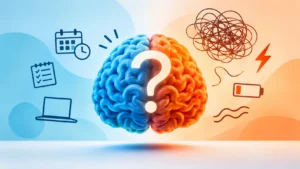
People experiencing long COVID-related cognitive symptoms often describe a cluster of related difficulties: trouble concentrating or sustaining attention, word-finding difficulty, slowed information processing, short-term memory lapses, and a sense of mental fatigue that can worsen with cognitive or physical exertion. This last feature, sometimes related to post-exertional malaise, a pattern also seen in chronic fatigue syndrome, is an important consideration, since pushing through cognitive fatigue can sometimes worsen symptoms for some individuals, making pacing an important part of managing these symptoms.
How Neurofeedback Is Being Explored for Long COVID
Neurofeedback provides real-time feedback about a person’s brainwave activity, allowing them to practice shifting their brain toward patterns associated with improved regulation, typically over a structured series of sessions. For long COVID specifically, interest in neurofeedback relates to its potential to support both cognitive function and the autonomic nervous system dysfunction that appears to contribute to symptoms for some individuals.
Because long COVID itself is a relatively recently characterized condition, research specifically examining neurofeedback for long COVID-related cognitive symptoms is still in early stages, with a smaller number of studies and clinical reports available compared to more established neurofeedback applications. Some early research and clinical observations have reported improvements in cognitive symptoms and quality of life among long COVID patients using neurofeedback, though this research base remains limited, and larger, more rigorous studies are needed before firm conclusions can be drawn.
Given the still-developing nature of this research, and the overlap with the pacing-related considerations relevant to conditions like chronic fatigue syndrome, neurofeedback for long COVID should currently be considered an emerging, exploratory option, best pursued alongside appropriate medical care rather than as a stand-alone first-line approach.
The Importance of Pacing and Avoiding Overexertion
Given the post-exertional malaise pattern reported by some long COVID patients, any intervention, including neurofeedback, needs to be approached thoughtfully in terms of session intensity and frequency to avoid inadvertently triggering a symptom flare. This consideration should be discussed explicitly with any provider, and a provider experienced with post-viral or chronic fatigue-related conditions is generally better positioned to approach this appropriately.
Why Comprehensive Medical Evaluation Remains Essential
Long COVID can involve a wide range of symptoms beyond cognitive fog, including cardiovascular, respiratory, and other systemic effects, and a comprehensive medical evaluation is an important foundation for anyone experiencing persistent post-COVID symptoms. This evaluation can help rule out other contributing or co-occurring conditions, guide appropriate medical management, and inform a safe, individualized approach to any complementary support being considered.
What a Coordinated Approach Might Involve
- A thorough medical evaluation, ideally with a physician experienced in long COVID or post-viral conditions, to understand the full symptom picture and rule out other contributing factors
- Careful attention to pacing, balancing activity and rest to avoid triggering post-exertional symptom flares
- Addressing foundational factors like sleep, hydration, and gradual, appropriately paced physical activity, which are commonly part of long COVID management
- Exploration of neurofeedback as a complementary, still-developing option, with realistic expectations and session pacing calibrated to individual tolerance
- Ongoing coordination with the person’s medical team throughout the process
What a Neurofeedback-Informed Approach Might Involve
At Bhakti Brain Health Clinic, exploring neurofeedback for long COVID-related cognitive symptoms typically begins with qEEG brain mapping to better understand an individual’s specific patterns of brain activity, along with careful discussion of their symptom history, activity tolerance, and current medical care. Session pacing is approached thoughtfully given the post-exertional sensitivity some individuals experience, and this approach is explicitly framed as complementary to, not a replacement for, appropriate medical evaluation and care.
What This Means for You
Long COVID brain fog reflects a genuine, actively researched set of cognitive symptoms, likely related to a combination of neuroinflammation, vascular changes, and autonomic nervous system dysfunction, though the exact mechanisms are still being clarified by ongoing research. Neurofeedback is an emerging, still-developing option that some individuals explore as a complementary approach, with early but limited research support, and it should be pursued alongside, not instead of, comprehensive medical care, with careful attention to pacing given the post-exertional sensitivity many long COVID patients experience.
FAQs
Is long COVID brain fog a recognized medical condition?
Yes, cognitive symptoms are a commonly reported and increasingly well-documented feature of long COVID, also referred to as post-acute sequelae of COVID-19, and researchers are actively working to better understand the underlying mechanisms involved.
What causes long COVID brain fog?
Researchers have proposed several contributing mechanisms, including neuroinflammation, microvascular changes affecting blood flow to the brain, and autonomic nervous system dysfunction, though this remains an active area of scientific investigation, and the relative contribution of each factor likely varies between individuals.
Is there strong research on neurofeedback for long COVID specifically?
Research in this specific area is still in early stages, given how recently long COVID has been characterized as a condition. Some early reports are encouraging, but the evidence base remains more limited than for many other, more established neurofeedback applications.
Why does pacing matter for someone with long COVID considering neurofeedback?
Many long COVID patients experience post-exertional malaise, where overexertion, including cognitive exertion, can worsen symptoms. Any intervention, including neurofeedback, should be approached with careful attention to session intensity and frequency to avoid triggering this kind of symptom flare.
Should someone with long COVID see a doctor before trying neurofeedback?
Yes, a comprehensive medical evaluation is an important first step for anyone experiencing persistent post-COVID symptoms, both to understand the full symptom picture and to help guide a safe, individualized approach to any complementary support being considered.
If you’re navigating persistent brain fog or cognitive symptoms after COVID-19, Bhakti Brain Health Clinic can help you explore a carefully paced, complementary approach alongside your medical care.