Buy or rent our products online!
Attention-deficit hyperactivity disorder (ADHD) affects approximately 8.8% of children and 2.5% of adults worldwide. While stimulant medications remain the most prescribed intervention, a substantial and growing body of research confirms that several non-pharmacological treatments produce clinically significant improvements in attention, impulse control, and executive function. For families, adults, and clinicians exploring ADHD treatment without medication, the evidence is clearer than ever: the brain can be retrained.
This article outlines the most effective brain-based, non-drug interventions — what the research shows, how each works at the neurological level, and what realistic outcomes look like.
Why the Brain, Not Just Behavior, Is the Target
ADHD is a neurodevelopmental disorder rooted in dysregulation of the prefrontal cortex the brain region governing working memory, inhibitory control, and cognitive flexibility. Dopamine and norepinephrine signaling in this region function below optimal levels, which explains the hallmark symptoms: inattention, impulsivity, and hyperactivity.
Effective non-medication treatments do not simply mask symptoms. The most evidence-backed interventions physically alter brain activity, strengthen neural pathways, and recalibrate the theta/beta brainwave ratio, a key neurological marker measured through qEEG brain mapping.
The 2019 American Academy of Pediatrics (AAP) guidelines formally recognize behavior therapy as the first-line treatment for children ages 4 to 5, and as a concurrent intervention alongside medication for ages 6 to 18. For many individuals, non-pharmacological approaches are not a secondary option; they are the primary protocol.
Neurofeedback: Retraining the ADHD Brain Directly
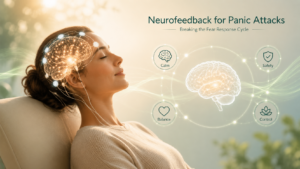
Neurofeedback (EEG biofeedback) is one of the most studied non-medication ADHD interventions. It works by measuring real-time brainwave activity and feeding that information back to the patient, who learns through repeated sessions to voluntarily shift brain states toward patterns associated with focused attention.
In ADHD, the brain typically produces excess theta waves (associated with daydreaming and mental drift) and insufficient beta waves (associated with alert, focused processing). Neurofeedback systematically corrects this ratio.
A 2014 meta-analysis published in the Journal of Child Psychology and Psychiatry found neurofeedback produced effect sizes comparable to medication for inattention and impulsivity. A 2025 review in Brain and Behavior confirmed sustained improvements at 6-month follow-up, indicating lasting neurological change, not temporary symptom suppression.
Sessions required: typically 30–40 sessions, 2–3 times per week.
Cognitive Behavioral Therapy and Executive Function Training
Cognitive behavioral therapy (CBT) adapted for ADHD targets the executive dysfunction that underlies most daily impairments. Unlike general CBT, ADHD-specific protocols address time blindness, emotional dysregulation, disorganization, and impulsivity — not just thought patterns.
Published data from the MTA Cooperative Group and subsequent studies show that structured behavioral interventions produce statistically significant improvements in organizational skills, academic performance, and parent-rated behavior. The Pelham et al. findings further demonstrated that behavioral-first treatment sequences outperform medication-first approaches in long-term adaptive functioning.
Executive function training delivered through ADHD coaching or structured skills programs directly targets working memory, cognitive flexibility, and inhibitory control. These are the three core executive function domains most impaired in ADHD, and each responds measurably to consistent, goal-directed practice.
Mindfulness-based cognitive therapy (MBCT) is an evidence-supported extension of CBT that trains sustained attention and emotional regulation through present-moment awareness exercises. A 2023 systematic review in The Lancet classified MBCT among the treatments with the strongest non-pharmacological evidence base for adult ADHD.
Exercise: The Most Underutilized Brain-Based Intervention
Aerobic exercise is not merely supportive; it is neurologically active. Physical activity increases dopamine, norepinephrine, and serotonin availability in the prefrontal cortex, the same mechanism targeted by stimulant medications, without pharmacological side effects.
A 2024 meta-analysis covering 14 randomized controlled trials found that regular aerobic exercise produced a combined executive function effect size of g = 0.673, with inhibitory control showing the strongest response (g = 0.900). Activities with the highest evidence base include: running, cycling, martial arts, swimming, and structured ball sports.
For children and adults with ADHD, 20 to 30 minutes of moderate-to-vigorous aerobic activity performed at least 4 times per week produces measurable improvements in attention span, impulse control, and emotional regulation. Mind-body practices such as yoga and tai chi show additional benefits for self-regulation and anxiety reduction, which frequently co-occur with ADHD.
Nutrition, Supplements, and the ADHD Diet
Dietary patterns influence neurological function and, by extension, ADHD symptom severity. Research identifies several nutritional factors with clinical relevance:
- Omega-3 fatty acids (EPA/DHA): A 2018 meta-analysis in Neuropsychopharmacology found significant improvements in attention and hyperactivity. Typical doses studied range from 750 mg to 2,000 mg EPA+DHA daily.
- Magnesium: Deficiency is found in a higher proportion of children with ADHD than in neurotypical controls. Supplementation trials report reductions in hyperactivity and impulsivity.
- Zinc and iron: Both minerals support dopamine synthesis. Low serum ferritin and zinc levels correlate with greater ADHD symptom severity, and correction of deficiencies shows measurable clinical benefit.
- Food additives and dyes: Systematic reviews, including a 2007 Lancet study, confirm that certain artificial color additives increase hyperactivity in children both with and without ADHD.
An elimination approach removing artificial additives, reducing refined sugars, and ensuring adequate protein intake is a reasonable, low-risk dietary modification supported by available evidence. Nutritional interventions work best as adjuncts to behavioral and cognitive therapies, not standalone treatments.
Sleep Hygiene and Structured Routines
Sleep dysregulation and ADHD share a bidirectional relationship. 50 to 70% of individuals with ADHD report significant sleep difficulties, including delayed sleep onset, frequent night waking, and early morning waking. Disrupted sleep worsens executive dysfunction, attention, and emotional regulation, creating a compounding cycle.
Structured sleep hygiene interventions, consistent sleep and wake times, elimination of screens 60 minutes before bed, cooler sleep environments, and melatonin (0.5 to 3 mg), where clinically appropriate, significantly reduce sleep-related ADHD symptom burden.
External structure functions as a cognitive prosthetic for the ADHD brain. Consistent daily routines, visual schedules, time-blocking systems, and organizational tools reduce the cognitive load placed on an already-challenged prefrontal cortex. ADHD coaching formalizes this process and has demonstrated effectiveness in adult populations where self-directed structure is hardest to sustain.
Emerging Interventions: Brain Stimulation
The FDA has cleared two non-medication devices for ADHD treatment. EndeavorRx — a prescription digital therapy delivered via video game format — targets attentional networks and is approved for children ages 8 to 12. The Monarch external Trigeminal Nerve Stimulation (eTNS) device is cleared for pediatric ADHD and delivers low-level electrical pulses to stimulate the prefrontal cortex during sleep, with a 2019 randomized trial reporting a 26.4% reduction in ADHD Rating Scale scores versus placebo.
Transcranial direct current stimulation (tDCS) remains under investigation but shows early-stage promise in targeting prefrontal hypoactivation, the core neurological deficit in ADHD.
Building a Non-Medication Treatment Plan: What the Evidence Recommends
The most effective approach to ADHD treatment without medication combines multiple evidence-based modalities rather than relying on any single intervention. Based on published research and clinical guidelines, a comprehensive non-pharmacological protocol includes:
- Behavioral therapy or CBT as the primary therapeutic anchor
- Neurofeedback as a direct neurological intervention
- Consistent aerobic exercise, minimum 4 sessions per week
- Targeted nutritional support (omega-3s, corrected micronutrient deficiencies)
- Sleep hygiene optimization
- Executive function coaching and structured daily routines
At Bhakti Brain Health Clinic, each patient receives a personalized treatment plan built on qEEG brain mapping, identifying individual neurological patterns before any intervention begins. This ensures that every non-medication strategy is calibrated to the specific brain, not a generalized ADHD profile.
The research is unambiguous: ADHD is a brain-based condition, and the most durable solutions address the brain directly.
FAQs
1. Can ADHD be treated without medication?
Yes. Evidence-based non-medication treatments — including cognitive behavioral therapy, neurofeedback, aerobic exercise, and nutritional interventions — produce clinically significant improvements in attention, impulse control, and executive function. The AAP recognizes behavior therapy as a first-line treatment for children ages 4 to 5.
2. What is the most effective natural treatment for ADHD?
Aerobic exercise and cognitive behavioral therapy have the strongest evidence base. Exercise increases dopamine and norepinephrine in the prefrontal cortex. A 2024 meta-analysis found aerobic exercise produced an executive function effect size of g = 0.673, comparable to low-dose stimulant medication in several studies.
3. Does neurofeedback actually work for ADHD?
Yes. Neurofeedback retrains brainwave patterns associated with ADHD — specifically the elevated theta/beta ratio. Published meta-analyses show effect sizes comparable to medication for inattention and impulsivity, with sustained improvements confirmed at 6-month follow-up in 2025 peer-reviewed research.
4. What helps ADHD without medication in adults?
For adults, the most evidence-supported strategies are ADHD-specific CBT, mindfulness-based cognitive therapy, ADHD coaching for executive function, regular aerobic exercise, and structured daily routines. Omega-3 supplementation and corrected micronutrient deficiencies also show measurable benefit in adult populations.
5. How do you manage ADHD in children without medication?
The 2019 AAP recommends behavior therapy as the first-line treatment for children ages 4 to 5 and a core component for ages 6 to 18. Additional interventions include neurofeedback, structured routines, parent training in behavior management, dietary modifications, and omega-3 supplementation.
6. What foods help with ADHD symptoms?
Foods high in protein, omega-3 fatty acids (salmon, walnuts, flaxseed), zinc (beef, pumpkin seeds), and iron (lentils, spinach) support dopamine synthesis. Reducing artificial food dyes and refined sugars is supported by peer-reviewed evidence, including a 2007 Lancet study on hyperactivity.
7. Is ADHD without medication better long-term?
Research by Pelham et al. found that behavioral-first treatment sequences produce better long-term adaptive functioning than medication-first approaches. Non-medication interventions that retrain executive function and neurological patterns — such as neurofeedback and CBT — show durable outcomes beyond the active treatment period.