Buy or rent our products online!
Depression is not simply sadness, a mindset, or a weakness of character. Major depressive disorder (MDD) is a brain disorder — one driven by measurable disruptions in the neural circuits that regulate mood, motivation, emotional experience, and cognitive function. And because depression originates in the brain, a treatment that directly targets the brain’s electrical activity offers something that medication and talk therapy alone often cannot: access to the neurological root of the problem.
Neurofeedback for depression does exactly that. By training the brain’s own brainwave patterns in real time, neurotherapy for depression helps rewire the mood centers that drive anhedonia, hopelessness, fatigue, low motivation, and emotional dysregulation — without medication, without invasive procedures, and with the guidance of objective brain data.
At Bhakti Brain Health Clinic in Edina, Minnesota, we use quantitative EEG (qEEG) brain mapping to identify each patient’s unique depression signature before designing a personalized, drug-free neurofeedback protocol. In this article, we explain what is happening in the depressed brain, how EEG biofeedback targets the brain’s mood centers, what the clinical research shows, and what patients in Minnesota can expect from this approach.
What Is Happening in the Depressed Brain?
Depression is associated with a consistent and measurable pattern of brain dysregulation — one that shows up in both structural imaging and EEG studies and that helps explain why so many people with MDD feel stuck, unmotivated, and unable to simply “think” their way out of how they feel.
The Dorsolateral Prefrontal Cortex — The Brain’s CEO of Mood
The dorsolateral prefrontal cortex (DLPFC) is the primary mood regulation center of the brain — responsible for executive function, approach motivation, positive affect, and the top-down regulation of emotional reactivity. In major depressive disorder, the left DLPFC is measurably underactive. It loses its ability to generate the energy, motivation, and positive engagement with life that defines a healthy mood — and it loses its capacity to regulate the amygdala, the brain’s fear and reactivity center, which then operates with less oversight.
At the same time, the right prefrontal cortex becomes relatively overactive, driving withdrawal motivation, negative affect, and the persistent sense that nothing is worth doing. The anterior cingulate cortex — responsible for error detection and emotional conflict — becomes dysregulated, reinforcing rumination and low mood. The hippocampus, central to memory and emotional context, can show volume reduction in chronic depression. And the default mode network — the brain’s “resting” network associated with self-referential thought — becomes overactive, feeding the cycle of negative rumination that defines depressive thinking.
Frontal Alpha Asymmetry — The Brainwave Signature of Depression
When we perform a qEEG brain map on a patient with depression, one of the most consistent findings is frontal alpha asymmetry (FAA): an excess of alpha brainwaves (8–12 Hz) over the left frontal region relative to the right. Because alpha waves are inversely related to brain activation — more alpha means less activity in that region — elevated left-frontal alpha is the electrical signature of the underactive left DLPFC. This asymmetry, first established through the research of neuroscientist Richard Davidson in the 1990s, has become one of the most replicated biological markers of depression and predisposition to negative mood states.
This is a measurable, visible pattern — and most importantly, a trainable one. This is where neurofeedback for depression begins its work.
How Neurofeedback Rewires the Brain’s Mood Centers
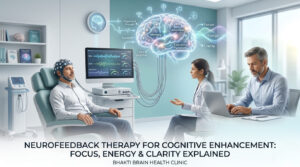
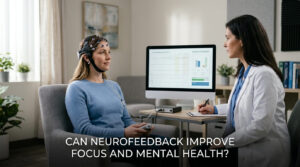
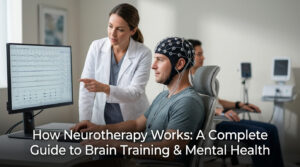
Neurofeedback — also known as EEG biofeedback or brainwave training — is a non-invasive, real-time brain monitoring technique. Sensors placed on the scalp continuously measure brainwave activity. That activity is translated into an audio or visual signal — a video, tone, or game — that responds moment by moment to what the brain is doing. Through a process of operant conditioning, the brain gradually learns brainwave self-regulation: reinforced for producing healthier patterns, it shifts away from the dysregulation that underlies depression.
The Alpha Asymmetry Protocol (ALAY)
The primary evidence-based neurofeedback protocol for depression is the alpha asymmetry protocol — sometimes called the ALAY protocol. The goal is to reduce left-frontal alpha power while enhancing left-frontal beta activity (particularly the 15–18 Hz frequency range), effectively increasing left DLPFC activation and restoring the approach motivation, positive affect, and emotional regulation that depression suppresses.
For patients with co-occurring depression and anxiety — an extremely common comorbidity — high-beta down-training at posterior brain sites addresses the hyperarousal component alongside the mood deficit. And for some patients, targeting the theta/beta ratio within the left prefrontal cortex provides an additional avenue for clinical improvement. The specific protocol chosen depends entirely on what the individual’s qEEG brain map reveals.
Why qEEG Brain Mapping Comes First at Bhakti
Not every depressed brain shows identical patterns. Some patients present with clear FAA at frontal electrodes. Others show DLPFC-precuneus connectivity disruption, slow frontal brainwaves, or posterior high-beta overactivation from comorbid anxiety. A generic neurofeedback protocol assumes a pattern that may not match this patient’s brain.
At Bhakti Brain Health Clinic, every patient begins with a full qEEG brain mapping assessment before any training session takes place. The brain map provides an objective, data-driven picture of exactly where dysregulation is occurring. And drives a genuinely personalized neurofeedback protocol built around that individual’s neural signature, not a one-size-fits-all approach. This is Bhakti’s most significant clinical differentiator, and a major gap in how most neurofeedback providers approach depression treatment.
What Does the Research Show?
The evidence base for neurofeedback in depression has grown substantially over the past two decades. Here are the most clinically relevant findings:
| 58.3%
Response rate in treatment-resistant depression (PMC 2019) |
12 Studies
Systematic review showing significant cognitive & clinical improvements (PMC 2023) |
| 183 / 334
Patients with depression/anxiety improved after 30 sessions + HRV training (Fotuhi) |
1–5 Years
Follow-up study showing maintained depression improvement post-neurofeedback (Baehr 2001) |
A 2023 systematic review covering 12 studies found that patients with major depressive disorder who underwent EEG neurofeedback training showed significant improvements in cognitive function, clinical depression ratings, and neural connectivity measures compared to control groups.
A 2019 open-label pilot study (PMC) specifically enrolled patients with treatment-resistant depression — those who had already failed two or more antidepressant trials. After 12 weeks of neurofeedback augmentation, 58.3% of participants met criteria for treatment response on the Hamilton Depression Rating Scale (HAM-D). The neurofeedback augmentation group also showed measurable increases in brain-derived neurotrophic factor (BDNF) — a neurotrophin closely associated with neuroplastic recovery and antidepressant response.
Research by Baehr et al. (2001) demonstrated that improvements achieved through the alpha asymmetry neurofeedback protocol were maintained at 1 to 5 year follow-up — a finding that distinguishes neurofeedback from pharmacological approaches, where symptom return after discontinuation is common because the underlying brainwave dysregulation has not been addressed.
A large naturalistic study by Fotuhi et al. found that 183 of 334 clients presenting with depression and anxiety showed substantial clinical improvement following approximately 30 neurofeedback sessions combined with heart rate variability (HRV) training — underscoring the value of the combined neurotherapy approach Bhakti offers.
Neurofeedback for Treatment-Resistant Depression
Approximately 30% of people diagnosed with major depressive disorder do not achieve adequate relief from conventional first-line treatments — including SSRIs, SNRIs, and psychotherapy. This is the population defined as having treatment-resistant depression (TRD), and it represents one of the most underserved groups in mental health care.
For patients with TRD, neurofeedback offers a meaningful, evidence-backed pathway — not as a replacement for medication, but as an augmentation strategy that targets the neurological dimension conventional treatments leave unaddressed. The 2019 PMC pilot study demonstrated this directly: patients who added neurofeedback training to their existing medication regimen showed superior outcomes versus those continuing medication alone — including the BDNF increase that signals genuine neuroplastic change rather than symptomatic suppression.
If you have tried antidepressants without satisfactory relief — or experienced side effects that made ongoing medication difficult — neurofeedback for depression may address the layer of neurological dysregulation that pharmacological treatment alone cannot reach.
Neurofeedback vs. Antidepressants: A Complementary Approach
Neurofeedback is not positioned as a replacement for antidepressants in every clinical context. But understanding the difference in how they work helps clarify why many patients benefit from both — and why some prefer neurofeedback as a drug-free depression treatment.
How Neurofeedback Differs from Antidepressants• SSRIs and SNRIs modulate neurotransmitter levels externally — when discontinued, the underlying brainwave dysregulation and neural predisposition to depression remain unchanged • Neurofeedback trains the brain’s own regulatory mechanisms through neuroplasticity — changes can persist after training ends, because the brain has learned new patterns (Baehr 1–5 year follow-up) • Neurofeedback augmentation + existing medication outperforms medication alone in treatment-resistant cases (PMC 2019) • No medication side effects, dependency risk, or withdrawal effects — completely drug-free and non-invasive • TMS (transcranial magnetic stimulation) uses external magnetic pulses to stimulate brain regions; neurofeedback uses the brain’s own electrical signals — a fundamentally different mechanism that does not require external stimulation • Heart rate variability (HRV) training, offered alongside neurofeedback at Bhakti, strengthens the parasympathetic nervous system — a powerful complement to frontal mood regulation training |
Frequently Asked Questions
Can neurofeedback help depression?
Yes. Clinical evidence — including a 12-study systematic review showing significant cognitive and clinical improvements, a pilot study reporting a 58.3% response rate in treatment-resistant depression, and a 1–5 year follow-up study showing maintained outcomes — supports neurofeedback as an effective, drug-free depression treatment. Results are strongest when protocols are guided by qEEG brain mapping.
What part of the brain does neurofeedback target for depression?
Neurofeedback for depression primarily targets the dorsolateral prefrontal cortex (DLPFC) — the brain’s mood regulation center — by addressing frontal alpha asymmetry: the excess of left-frontal alpha waves that corresponds to underactivation of the left DLPFC. Protocols also address the amygdala, anterior cingulate cortex, hippocampus, and default mode network depending on each patient’s qEEG findings.
How many neurofeedback sessions are needed for depression?
Most patients undergo 25 to 40 sessions, typically conducted 2 to 3 times per week. The ASEBA naturalistic study used approximately 30 sessions as its benchmark. The TRD pilot study showed significant response after 12 weeks of training. Many patients notice meaningful mood shifts within the first 15 to 20 sessions — and progress is tracked with periodic repeat qEEG assessments.
Does neurofeedback work for treatment-resistant depression?
Yes — and this is one of neurofeedback’s most clinically significant applications. A 2019 open-label pilot study specifically studied patients who had failed two or more antidepressant trials. After 12 weeks of neurofeedback augmentation, 58.3% achieved treatment response on the Hamilton Depression Rating Scale. The group also showed increased levels of BDNF — a neurotrophin associated with neuroplastic recovery.
Can I do neurofeedback while taking antidepressants?
Yes. Neurofeedback is safe to use alongside antidepressant medication. In the TRD pilot study, neurofeedback was added to existing medication and produced superior outcomes compared to medication alone. Many patients use neurofeedback as an augmentation strategy — and some, working closely with their prescribing physician, find that sustained neuroplastic improvement over time allows for a gradual reduction in medication needs.
Neurofeedback for Depression at Bhakti Brain Health Clinic — Edina, MN
Bhakti Brain Health Clinic is a specialist neurotherapy clinic in Edina, Minnesota, serving patients throughout the greater Minneapolis–Saint Paul area. We offer qEEG-guided neurofeedback as the foundation of a personalized, non-invasive, medication-free depression treatment approach — and we work collaboratively with referring therapists and psychiatrists to ensure integrated, comprehensive care.
Every patient begins with a 45-minute initial consultation, followed by a full qEEG brain mapping assessment. From there, we design a personalized neurofeedback protocol targeting your brain’s specific depression signature — whether that is frontal alpha asymmetry, DLPFC dysregulation, posterior high-beta overactivation, or a combination. Where appropriate, we complement neurofeedback with heart rate variability (HRV) training to strengthen the parasympathetic nervous system alongside mood regulation training.
We also offer our Neurotherapy Grant Program for patients who need financial assistance to access treatment. Depression is a brain disorder — and your brain has the neuroplasticity to learn something new. Let us show you what that looks like.
Ready to Rewire Your Brain’s Mood Centers?At Bhakti Brain Health Clinic in Edina, MN, we begin with a qEEG brain map to identify your brain’s unique depression signature — then build a personalized, drug-free neurofeedback protocol designed specifically for your neural patterns. → Schedule Your Free Initial Consultation ←bhaktibrainhealthclinic.com • 888-783-BBHC (2242) • 7300 Metro Blvd #340, Edina, MN 55439 |
Neurofeedback for depression is not a replacement for every treatment that works. It is a neurologically grounded, evidence-supported pathway that targets the brain’s mood centers directly. Where antidepressants and talk therapy alone often cannot reach. By retraining the frontal alpha asymmetry. Restoring left DLPFC function, and supporting neuroplastic recovery through personalized. QEEG-guided protocols, neurofeedback offers a drug-free route to lasting mood regulation change.
For patients in Minnesota — including those with treatment-resistant depression. Those seeking antidepressant alternatives, and those who simply want a data-driven brain health approach to their mental wellbeing. Bhakti Brain Health Clinic is here to help.