Buy or rent our products online!

Few ideas about the nervous system have spread as widely as polyvagal theory. It appears in therapy rooms, yoga classes, wellness podcasts, and social media posts promising to “reset your vagus nerve.” Many people find its language, with talk of safety, shutdown, and connection, helpful for making sense of their own reactions. Others have heard that the science behind it is disputed.
Both things can be true. This article explains what the vagus nerve actually does, what polyvagal theory proposes, where researchers disagree, and how to use the ideas sensibly without over-relying on them. It is educational only and is not a substitute for medical or psychological care.
What the Vagus Nerve Actually Is
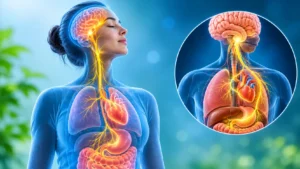
The vagus nerve is the tenth cranial nerve and one of the longest nerves in the body. It runs from the brainstem through the neck and chest to the abdomen, connecting the brain with organs including the heart, lungs, and gut. The name comes from the Latin for “wandering.”
It is a major part of the parasympathetic nervous system, the branch that supports rest, digestion, and recovery. A notable fact is that most of its fibres carry information from the body to the brain, not the other way round. In other words, it is largely a channel for the brain to receive signals about what is happening inside the body.
The vagus nerve helps regulate heart rate, digestion, and aspects of breathing. This is well established and is not controversial.
What Polyvagal Theory Proposes
Polyvagal theory was developed by neuroscientist Stephen Porges. It proposes that the autonomic nervous system responds to cues of safety and danger through three broad states, linked to different neural pathways:
- A “social engagement” state, associated with feeling safe, connected, and calm, in which people can listen, converse, and relax.
- A “mobilisation” state, associated with the sympathetic nervous system and fight-or-flight responses to perceived threat.
- A “shutdown” state, associated with freeze or collapse, numbness, and withdrawal in response to overwhelming threat.
The theory also introduces the idea of neuroception, an unconscious process by which the nervous system scans for safety or danger before we are consciously aware of it. Many therapists find this a helpful way to explain why someone can feel unsafe in a situation that appears harmless to others.
Why People Find It Useful
For many people, the framework offers a non-judgemental vocabulary. It suggests that responses like freezing during conflict, feeling numb under stress, or becoming irritable when overwhelmed are automatic nervous-system reactions rather than moral failings. It also emphasises the role of safe relationships, which fits with a large body of research showing that social connection supports wellbeing.
Related ideas, such as the window of tolerance and the fight, flight, freeze, and fawn framework, are often discussed alongside it. Our articles on those topics may be useful companions.
Where the Science Is Debated
It is important to be honest that polyvagal theory is contested among researchers. Some physiologists and neuroscientists have published detailed critiques, arguing that:
- The proposed evolutionary story, in which a “newer” vagal pathway evolved in mammals to support social behaviour, is not well supported by comparative anatomy.
- The claim that distinct vagal pathways map neatly onto specific emotional states is an oversimplification of how the autonomic nervous system works.
- Some of the theory’s predictions about heart rate variability and vagal function have not held up consistently in research.
Supporters respond that the framework remains clinically useful and continues to generate research. A balanced reading is that the theory is better viewed as a useful clinical metaphor and working framework than as an established, fully validated model of the nervous system. The observation that safety, connection, and stress influence bodily states is well supported. The detailed mechanisms proposed by the theory are less settled.
Can You “Stimulate” or “Reset” Your Vagus Nerve?
Social media is full of vagus nerve “hacks,” such as cold water on the face, humming, gargling, and certain breathing patterns. Some context is helpful.
- Medical vagus nerve stimulation is a real treatment. An implanted device that stimulates the vagus nerve is approved in some countries for certain kinds of epilepsy and treatment-resistant depression. This is a medical procedure, not a home technique.
- Slow breathing, particularly with longer exhalations, is associated with changes in heart rate variability and feelings of calm in many studies. Effects are modest and vary between people.
- Other popular techniques such as humming, cold exposure, or massage have limited direct evidence for changing vagal function in a meaningful way, though some people find them relaxing.
There is no reliable way to “fix” or “reset” the vagus nerve in a single exercise, and claims of that kind should be treated with caution. Calming practices can still be useful for stress, even without a precise vagal explanation.
Using the Ideas Sensibly
If you find polyvagal language helpful, a few principles keep it grounded:
- Treat it as a framework, not a diagnosis. Terms like “dorsal shutdown” are not diagnoses and cannot be measured with a simple test.
- Avoid over-interpreting symptoms. Fatigue, numbness, palpitations, and digestive problems can have many medical causes. Persistent physical symptoms deserve medical evaluation.
- Focus on what you can do. Regular sleep, movement, time outdoors, supportive relationships, and professional help where needed are well supported ways to ease stress.
- Be wary of promises. Any program claiming to cure trauma, anxiety, or chronic illness by “healing the vagus nerve” goes beyond the evidence.
When to Seek Professional Support
Consider speaking with a doctor or mental health professional if stress, anxiety, shutdown, or physical symptoms are persistent or interfering with daily life. Trauma-informed therapy, medical review, and other supports can be tailored to your circumstances.
Where Brain-Based Assessment May Fit
At Bhakti Brain Health Clinic, an assessment-led approach to stress and nervous-system regulation considers history, symptoms, and goals. qEEG brain mapping may provide quantitative information about brain activity patterns that a practitioner can consider alongside other findings, but it does not measure vagus nerve function or confirm any polyvagal state. Neurofeedback is explored by some people as a complementary way to support regulation and does not replace therapy or medical care.
What This Means for You
The vagus nerve is a real and important part of how your brain and body communicate. Polyvagal theory offers a popular and often helpful way of talking about safety, stress, and connection, but its detailed claims are debated and should not be treated as settled fact. Use it as a lens rather than a rulebook, and rely on well supported habits and professional help for stress that does not ease.
FAQs
What does the vagus nerve do?
It connects the brain to organs such as the heart, lungs, and gut and is a major part of the parasympathetic nervous system. It helps regulate heart rate and digestion and carries a large amount of sensory information from the body to the brain.
Is polyvagal theory scientifically proven?
It is influential but contested. Some of its ideas about safety and stress are widely accepted, while its specific claims about evolution and distinct neural pathways have been criticised by many researchers. It is best treated as a working framework.
Can I improve my vagal tone?
Regular exercise, good sleep, and slow breathing practices are associated with healthier heart rate variability in many people. There are no guaranteed quick fixes, and effects differ between individuals.
Do vagus nerve exercises work?
Some, such as slow breathing, may promote relaxation. Evidence for many popular “hacks” is limited. They are generally low risk, but they are not a substitute for treating anxiety, trauma, or medical conditions.
What is neuroception?
It is a term introduced by Stephen Porges for the unconscious process by which the nervous system evaluates cues of safety and threat. It is a useful concept clinically, though measuring it directly is not straightforward.
Can a qEEG measure my vagus nerve function?
No. A qEEG records electrical activity at the scalp and cannot measure vagus nerve function or confirm a polyvagal state.
If you are trying to understand how stress is affecting your body and brain, a personalised assessment can be a useful starting point. Bhakti Brain Health Clinic can help you explore next steps based on your individual concerns and goals.